
24 May 2026
9 years after the Grenfell tower disaster, the cover ups continue. So who’s on the hook to pay? How much will it cost? And how will the repercussions affect the construction industry? Will the cure be more damaging than the disease? One 50 year old industry stalwart has already been forced into administration and another describes the Government’s solution to the problems raised by Grenfell as “existential to their business”.
We advise all developers and contractors to read this shocking summary of the investigation, its aftermath, and how the finger eventually (and inevitably) is pointed at you to carry the can.
It’s a longish read, but since almost every sentence is a shocker (especially when you get to the Building Safety Levy!) you’ll be glad you did – when you finally come down off the ceiling…
The regulatory firestorm that began with the Grenfell Tower Disaster shows few signs of abating. The inquiry’s Final Report, published on 4th September 2024, exposed structural weaknesses across Government departments, the construction industry, the regulatory bodies, the materials supply chain, the architect, the Royal Borough of Kensington and Chelsea and the London Fire Brigade.
So come with us on a disturbing parade down the Hall of Shame…
“An unedifying merry-go-round of buck-passing”
The report castigated “decades of failure” by all those involved. It claimed the way building safety is managed in England and Wales is “seriously defective” and that “matters affecting the safety of life were ignored, delayed or disregarded”.
It claimed the privatisation of the Building Research Establishment (BRE) in 1997 left the system exposed to “systematic dishonesty” from “unscrupulous product manufacturers” and building inspectors with a “commercial interest” in approving work.
It also accused the “trusted” BRE of “unprofessional conduct, inadequate practices, a lack of effective oversight, poor reporting and a lack of scientific rigour”. It suggested that its status as a private body was “compromising its integrity and independence” – in other words, the fact that the inspectors relied on repeat business from those it was inspecting created a clear conflict of interest through their “desire to accommodate” those customers.
It couldn’t be more damning if it had ordered them to be marched through the streets naked and pelted with dung.
“Persistent indifference” to fire safety
Furthermore, the report highlighted a “casual approach to contractual relations” between the architects, contractors and subcontractors and “persistent indifference” to fire safety from the Council.
It called the Tenant Management Organisation (TMO) an “uncaring and bullying overlord” which “manipulated the procurement process” in 2012 to appoint the architects, Studio E, without a public tender.
The same TMO, claimed the report, refused Studio E’s initial recommendation of aluminium cladding on the grounds of cost, which led to the use of the now infamous aluminium composite material (ACM) panels.
But then Studio E, it claimed, didn’t notice the type of ACM cladding it proposed was combustible – and so it “bears a very significant degree of responsibility for the disaster”.
Although, to be fair, the Government failed to tell the building sector about its tests in 2001 that showed this commonly used cladding material caused a “catastrophic escalation” of fire.
So just to recap – the Tenant Management Organisation – an organisation set up to enable residents of social housing to take over responsibility for the running of their homes – ran a dodgy process to appoint favoured architects, whose fire safety recommendation they then refused. Those architects then recommended a substitute fire safety product which burnt like a bundle of rags, as the Government knew it would, but failed to tell the building industry.
And that’s just the start of it….
“Even matters affecting the safety of life were ignored, delayed or disregarded”.
The report found the Cameron government’s obsessive drive to cut costs and remove barriers to building so “dominated” the culture that “even matters affecting the safety of life were ignored, delayed or disregarded”.
It exposed “systematic dishonesty”, and “false and misleading claims” from those who made and sold the cladding and insulation – including Arconic, who “deliberately concealed” the true extent of their product’s dangers.
Even the poor firefighters were caught in the backdraught, as the report found they were not properly trained to deal with such events, despite similar disasters occurring in recent years.
However, the most curious finding surrounded the construction industry’s relationship with the Building Control Officers.
Section 113.12 claims that “levels of competence in the construction industry are generally low”. Now this may come as a slap in the face, but on reading the report, this claim seems to be referring to legal competence, rather than the ability to build a straight line of bricks or plumb a sink.
“compliance with the guidance will not necessarily result in compliance with (the regulations)”
It criticises contractors for seeking guidance from building inspectors on what needs to be done, and then – of all things – doing it.
It therefore contains a warning for the future “that compliance with the guidance will not necessarily result in compliance with (the regulations)”. Which lifts all responsibility from the shoulders of the inspectors and plants it squarely (and unfairly) onto the contractor.
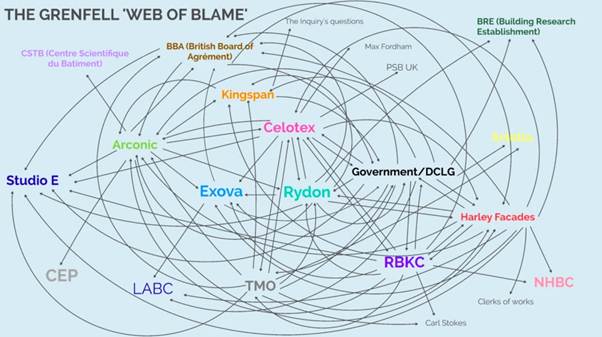
So as the flames of guilt flickered steadily around all these bodies, each was frantically blowing smoke in the direction of the others in what the report dubbed “an unedifying merry-go-round of buck-passing”.
Those tasked with seeing through the smoke faced an unenviable task, thanks to everyone’s pants being clearly on fire.
https://www.bbc.co.uk/news/articles/c049yvrd5qxo
Unhelpful recommendations
However, while some of the Enquiry’s recommendations are welcome, others seem very wide of the mark.
Not only will they do nothing to tackle the causes of Grenfell, but they’re already having disastrous consequences for the construction of high rise buildings, the companies that build them and their suppliers. The £313 million turnover contractor Ardmore Construction Ltd sank into administration last year under the weight of six remediation claims totalling £150 million. The company had been conducting a responsible and orderly wind-down – shouldering the £85 million costs of two remediations – until the BSA extended the statute of limitation for claims from 12 years to 30 years(!). And while few other construction companies have Ardmore’s exposure, several – including Taylor Wimpey, are pursuing their suppliers for compensation.
So, four elements of the report stand out as areas of particular concern:
- The attempt to tighten regulation using loosely worded diktats
- A Building Safety Regulator which has “zero incentive to approve anything”.
- “Planning Gateway 2”, and its potentially disastrous effect on the funding of Higher-Risk Buildings (HRB)
- The Building Safety Levy, and its effect on…well, everything.
We’ll explain what these mean for the industry below (and we’ve reserved a whole new blog post for the Levy) but first, let’s look at what’s happened so far…
What’s it all going to cost? Your guess is as good as the Government’s.
While reputations lie scorched and smouldering wherever one looks, the actual financial costs continue to burn through the early estimates.
Even at the lower end of those estimates, the cost of replacing cladding seems colossal – more than the infected blood scandal and Horizon compensation put together.
In 2020, the Government put the total remediation figure for all buildings over 11m at £15 billion.
Following the 101st Ministry of Housing, Communities and Local Government (MHCLG) Building Safety Remediation monthly data release in March 2026, the latest ‘best’ estimate hurtles – HS2-like – towards £23 billion, although, since the MHCLG doesn’t really know how many lower rise buildings are affected, this figure could be just pie in the …er… skyscraper.
Generously, the Government says it (i.e. you) will fund between £6.7 billion and £15.2 billion of this total, with the rest paid for by developers, private owners or social housing providers.
But then, the estimate could again double – or even quadruple – according to a specialist company which has actually carried out 20 such remediation projects in the real world.
Midlands cladding firm Colmore Tang criticised Building Safety Fund submissions which, it says, don’t account for the cost of permits, rising material costs, logistical challenges and scarcity of resources. It also helpfully points out that the estimates don’t include VAT – adding another 20% to the costs borne by “unfortunate occupiers”.
Nonetheless, the Secretary of State in charge of the MHCLG, Angela Rayner, proclaimed herself “astonished” at the lack of progress, telling the BBC that there is “no excuse” for building owners failing to act when “there is £5 billion of government funding available to support the programme”.
Well, Angela…the fact that the inquiry panel has spent nine years working out who to blame and has finally settled on “everyone” may explain why no-one has put their hand into their own pocket yet. And in the light of the above estimates, £5 billion seems like a drop in the inferno.
Following the Final Report, Ms Rayner pledged to respond, “within six months” as she hadn’t finished colouring it in ministers needed time to take in the 1,700 page document “in detail” and speak to building safety regulators and other Government departments. They finally published their response on 26th February 2025, and we summarise it below.
Meanwhile, the National Audit Office – the independent public spending watchdog – published its own, equally damning report on MHCLG’s progress within two months, on 4th November 2024.
How’s the Remediation going?
In the 2024 National Audit Office (NAO) Report, “Dangerous cladding: the Government’s remediation portfolio”, NAO chief Gareth Davies stated that the MHCLG had “considerable work ahead” to get back on schedule for building remediation and stick to its budget commitments. The report stated that “the scale of the cladding crisis has proved much bigger than the government initially understood, and its interventions have expanded as a result”.
At the time, the MHCLG estimated that between 9,000 and 12,000 residential buildings over 11 metres could contain unsafe cladding but admitted that as many as 7,200 of them – up to 60 per cent – had still not been identified. Worse still, the NAO warned that some buildings “may never be found”, thanks to “incomplete building records, construction materials that differ from those on plans and difficulties tracing owners”. It adds that buildings under 11m don’t have to be registered and suggests their owners may be reluctant to do so in case they fall outside the scope of funding.
So, when the NAO report was published, 4,771 buildings (or 98% of those taller than 11m) had been brought into the remediation programme – representing around 258,000 homes.
Remediation work had been completed on roughly a third of these. The rest had yet to be started, with lower rise buildings remaining the larger part of the problem.
At a generous estimate then, it took seven years for a possible 1500 buildings to be rectified out of a possible 12,000.
So, rightly recognising that progress has been too slow, in December 2024 the Government aimed its boot at the behinds of developers with the Remediation Acceleration Plan.
So what exactly is the Remediation Acceleration Plan?
The Remediation Acceleration Plan (RAP) proposed that by 2029, “all 18m+ (high rise) buildings with unsafe cladding in a Government funded scheme will have been remediated” and “every 11m+ building with unsafe cladding will either have been remediated, have a date for completion, or the landlords will be liable for severe penalties.”
The RAP introduced 3 key objectives, all backed by the threat of legal action against anyone not keeping up with the programme:
- Fix buildings faster: this sets a target for buildings where unsafe cladding is already identified: remediation work should have been well under way by the end of March 2025, and on the highest risk properties should be completed by July 2027.
- Identify all buildings with unsafe cladding: to improve transparency, all buildings over 11m must be registered and assessed, so that building owners, including RPs and developers, are clearly identified as responsible for taking action.
- Support residents: Proposed measures include reducing insurance premiums, extending the Waking Watch Replacement Fund to March 2026, and setting up a framework allowing shared owners to sublet properties, to ease the financial pressure.
What does the RAP mean for developers?
These new proposals will hopefully bring structure and much needed clarity to the remediation process and include:
- Voluntary joint action plan: Developers who sign the Developer Remediation Contract (DRC) commit to completing remediation works within defined timeframes, although there is some flexibility, and it’s not legally binding.
- Legislative changes and enforcement: new legislation will force building owners and developers to rectify unsafe cladding within a set timeline or face financial penalties.
- Regulatory support: enforcement and support systems will be beefed up. Local authorities and fire services will get enough funding to double enforcement activities and will have access to advice from experts.
- More draconian powers: one of the more extreme proposals (but perhaps necessary where the legal owner of a building is hard to identify) is the Government’s planned legislation to provide the Secretary of State and regulators with powers to compel entities to disclose their beneficial ownership chains.
- Long-term strategy for social housing: to include further funding opportunities and targeted support to help Registered Providers traverse the remediation process.
How the Government thinks it’s going – The March 2026 Remediation Update
As mentioned above, the Government now estimates that 4,322 residential buildings over 11 metres now sit within its “monitored remediation portfolio”, while admitting it doesn’t really have a clue how many there are in total.
So after nearly nine years of inquiries, consultations, funding schemes, regulators, gateways, levies, taskforces and enough procedural paperwork to dam the Thames, untold thousands of buildings still remain untreated.
Meanwhile, ACM remediation – the “Grenfell-style” cladding considered highest risk – is much further advanced. Of the 511 identified ACM high rise buildings over 18 metres, 497 (97%) had completed remediation works.
The Building Safety Fund figures are scarcely less bewildering. Hundreds of high rise residential buildings applied for funding through the scheme, with many projects still bogged down somewhere between approval, procurement, mobilisation, redesign, reassessment, dispute and actual (albeit confused) construction.
Under the Cladding Safety Scheme – covering buildings over 11 metres outside London and 11–18 metre buildings within London – progress remains slower still, particularly where ownership structures resemble a Russian nesting doll designed by Kafka.
Then there are the buildings where developers themselves are deemed responsible for the bill. More than 2,000 residential buildings over 11 metres have now been identified with “life-critical fire safety defects” – including both cladding and non-cladding defects. Developers claim that around half of these have now been remediated, with hundreds more under way.
Which all sounds like wonderful progress until you remember the small detail that Grenfell happened in 2017 – and the Government still can’t put a number on:
- how many affected buildings remain unidentified,
- how many lower rise buildings contain similar defects, or
- the final cost to the taxpayer and construction industry
A ‘substantial increase in remediation activity’
While the MHCLG is a long way off its 2035 target, still no target date has been set for completion of what remains a moving feast. But at the above rate, 2080 looks like a fair estimate.
However, the watchdog did concede that there was a ‘substantial increase in remediation activity’ in the second half of 2024 with several schemes brought together under one umbrella in 2023. These included:
- The £600 million ACM replacement funding programme – now closed to new applications
- The £4.5 billion Building Safety Fund (BSF) – now closed for new applications outside London – to support remediation of high rise buildings with non‑ACM flammable cladding
- The Cladding Safety Scheme (CSS) – funding remediation of buildings over 11 metres outside London and 11-18 metres inside London
- The Developer Remediation Programme, which oversees self‑remediation activity by developers
- The Social Housing Programme, which monitors self‑remediation in the social housing sector
It needs to be stressed that there’s zero government funding for the remediation of buildings below 11 metres – and MHCLG doesn’t have a Scooby how many of these there are – but owing to the “far lower” fire safety risk, it considers lower cost mitigations such as fire alarms sufficient to make them safe.
Nevertheless, the new Government gives itself a pat on the back for having “significantly changed” the scope and approach of remediation programmes, “as the scale and impact of the cladding problem has become clearer”.
It has also, it tells us, adopted a more “proportionate” approach towards building safety, recommending more lower cost mitigations such as sprinklers (“less disruptive for residents”), or “where risk is deemed low or ‘tolerable’” (!) to leave the flammable cladding in place.
Needless to say, such woolly words simply throw all the tickets back into the tombola.
As a result, we can expect years of protracted disputes between developers and the MHCLG – particularly with such substantial sums at stake.
Meanwhile, is there a “culture of silence” in the industry?
Dissenting voices are growing, feeling little has changed.
The Chairman of the Considerate Constructors Scheme (CCS) says the construction sector is “sleepwalking” towards another Grenfell style disaster due to a “culture of silence”, according to the non-profit organisation tasked with raising standards in the industry.
Amit Oberoi, executive chairman of the CCS said, “the Grenfell fire occurred because of a culture of chasing profits over performance and speed of delivery over safety”.
“But (there is) a culture of silence in the industry, which deters frontline construction staff from speaking out about dangerous or sub-optimal materials they are being asked to use in builds.”
He said that “every week” since the report was published, CCS had been approached by “workers of all backgrounds” saying they were “concerned and even frightened about the poor quality of materials they are being asked to use, either because of cost cutting or simply trying to build more with less”.
“These are good people trying to deliver high quality buildings that will last safely for generations,” he said.
“But many cannot – in good faith – carry on in an industry which does not want to raise standards.
These issues of quality and safety impact way beyond the public good but also speak to why many skilled people are leaving the building industry at the very moment we need them the most.”
But… what about the victims?
As the Watchdog’s report makes clear, the fallout from the dangerous cladding scandal has spread far beyond the immediate victims of the Grenfell fire – many more people are suffering “significant financial and emotional distress” thanks to the handling of the crisis.
As if living with the terror of being burnt in one’s bed and the lurking threat of remediation bills weren’t enough, many residents have been forced to pay for eyewateringly expensive ‘waking watches’ to patrol buildings while waiting for cladding to be removed. Costs for this vary, but in 2020 MHCLG gave median costs as “£11,361 per building per month, or £137 per home, compared to £104 per home in 2023 (based on buildings that were receiving Waking Watch Relief funding from the government)”.
What’s more, although most leaseholders are now protected from paying remediation costs by the Building Safety Act 2022, this hasn’t stopped their insurance premiums from rocketing – some by as much as £500 – and of course, being passed on through service charges. Many more have struggled to get mortgages and are trapped in unsafe homes, unable to sell.
And while the MHCLG has made some efforts to help make affected buildings mortgageable and insurable, it “acknowledges that its planned interventions are insufficient”.
This leaves many thousands of people in a hellish hinterland, with no idea of when their building will be made safe. The MHCLG puts the onus on “those responsible for fixing buildings to keep residents informed”. However, as we’ve seen, those responsible are hard to find, and even those building owners who are actually engaged in remedial work aren’t keen on being answerable to residents about delays.
The NAO wrapped up its report with guidance that, among other things, the MHCLG should consider how it might give residents a better idea of how long they’ll need to wait until their building is made safe (perhaps…you know… publish a target date, “based on its understanding of the number of buildings to be remediated and the speed at which it expects building owners and developers to complete works”). However, as we’ve seen above, this may not give the residents much hope.
It also demanded the MHCLG “continue to review whether the date remains achievable as the portfolio progresses” and increase transparency for Parliament and the public over portfolio performance – and therefore whether it is achieving value for taxpayers’ money or whether it needs to change the approach.
Taxpayers and residents are advised not to hold their breath.
Cut to the chase – How will the Grenfell recommendations affect construction?
The report set out 58 recommendations, of which the following are most relevant to the construction industry.
Key recommendations of the Inquiry for contractors.
- Contractors wishing to construct/refurbish Higher-Risk Buildings are to be licensed, “with the overall ambition of ensuring qualification by experience and organisation and increased competence”.
- Approved Documents and statutory guidance to be reviewed and revised by someone “with practical industry experience chosen for experience and skill”. (as if this is not a given?)
- Three new ‘Gateways’ at “key stages in design and construction, and…new requirements during construction, that will apply to higher-risk buildings”:
- Planning Gateway 1 – at the planning application stage
- Gateway 2 – before building work starts
- Gateway 3 – when building work is completed and prior to occupation
(Gateways 2 & 3 are “stop/go decision points that must be passed before a development can proceed to the next stage, strengthening regulatory oversight of design and construction”)
- Clear warnings that compliance with guidance will not necessarily result in compliance with Building Regulations. (The Inspector is not your friend.)
- Recommendation for Continuing Professional Development courses in fire engineering for construction professionals and members of the emergency services. (Fair enough.)
- A director/senior manager of the principal contractor must give a “personal undertaking” when applying for building control approval on construction or refurbishment of a HRB (Gateway 2) to “take all reasonable care to ensure that on completion and handover the building is as safe per Building Regulations”.
This last point is quite a bombshell.
Gateway 2 puts the top man in every building project in the firing line over some very fuzzy and fickle existential requirements. Which is a very uncomfortable place to be unless he or she is – or goes to the expense of hiring – a good lawyer.
In short Gateway 2 has the potential to cause serious bottlenecks – because it creates a situation where buildings under its remit can’t be started until the Regulator gives his say-so.
So let’s look at what this means in the real world.
The ‘disastrous’ Building Safety Regulator
“We have brought new leadership to the Building Safety Regulator who have immediately focused on speeding up decision making on building control approval”, claimed the Ministry for Housing recently, adding, “This will reduce unnecessary delays without compromising safety so we can build 1.5 million homes.”
Fine words, but they don’t chime with the reality. Just 342,100 net additional homes have been built since the current government came to office and 15 March 2026. Ben Hopkinson of the Centre for Policy Studies think tank explained that “a huge reason for that is the Building Safety Regulator.”.
The British Property Federation’s Dominic Curran endorses this view: “It’s among the top factors, if not the most significant, behind the lack of new homes. It’s being described by one of our members – a major developer – as existential to the survival of their business.”
Literally tens of thousands of new homes (and home improvements) are trapped in the Quango’s suffocating tendrils. One despairing applicant reported that, “The deadline comes and goes with no communication at all. The initial deadline was in May; they asked for an extension for four weeks. Then in June they asked for an extension for six more weeks.
“They say that if they don’t agree to the extension, your project is dropped and you’re denied permission”. So far, they’ve spent £5000 in application fees alone.
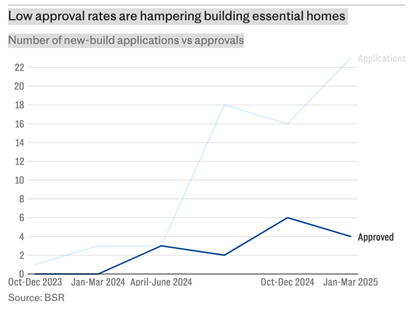
The BSR’s own figures are shocking. They rejected more than two thirds of pre-construction applications between October 2023 and March 2025. Since it took control, 193 new-build higher-risk building applications have been submitted, but only 15 have cleared the process successfully. The average waiting time is now 36 weeks – three times longer than the original target.
As Hopkinson summarises, “It’s a solution that has zero incentive to approve anything. In some cases, the BSR will continually ask for an extension with the implicit threat that if you don’t give it, they will just reject the application, while asking for more and more money. That sounds like an institution that won’t be suddenly and easily reformed to approve lots more homes and refurbishments.”.
What are the real world implications of Gateway 2?
Unfortunately, no-one really knows yet how this will pan out. Back in April 2024, the Building Safety Regulator published a list of documents developers would need to submit, but gave no hard guidance before the launch on the level of detail required.
Nor has it given clear direction onwhat the unnervingly elastic ‘plans and documents must be realistic for the building and not rely on unreasonable assumptions’ actually means in practice. It might as well just say, “Careful now!”.
Depending on the level of detail required for the Gateway 2 submission (the RIBA suggests shop drawing level information, no less), it may require the contractor (and even a subcontractor) to get involved right at the beginning of the design and build process. And yet, of course, as things grow and mutate throughout the development, there’s no guarantee that the information they give will remain relevant and accurate all the way through construction.
And if all this information was to be collated, submitted for approval and followed up at every building stage, what would be the cost and delay implications? Moreover, if there were any changes to what was approved (variations in materials, for instance), would you risk having to repeat the entire Gateway 2 process?
We’ll probably only find out the answers to these questions as new HRB developments come into the Gateway 2 process. And no doubt many more questions will arise as a result.
Which is a huge problem. Because when billion-pound liabilities, criminal exposure and project viability all hinge on vague wording interpreted by a regulator with effectively unlimited discretion and no responsibility, the process itself is the biggest risk.
Preventing bottlenecks by replacing the cork with a burning rag
In 2025, both the Government and The Construction Leadership Council (CLC) published guidance in an attempt to prevent the above process descending into administrative trench warfare.
Both made clear that Gateway 2 should not be underestimated as just another planning hurdle. Developers must now submit highly detailed, construction-ready information before work can begin – including fire and structural safety strategies, detailed designs, competency declarations, construction sequencing, change-control procedures and “golden thread” safety information. In practice, this means projects must be developed to roughly RIBA Stage 4 before approval is granted.
The CLC says many applications have been delayed because submissions were incomplete, inconsistent or lacked sufficient detail. The guidance therefore tries to establish a common baseline for what the Building Safety Regulator expects.
At the same time, the document indirectly acknowledges the industry’s frustration with the regime. Gateway 2 delays have created major uncertainty, rising costs and funding problems for high rise schemes, with approval times far exceeding statutory deadlines.
Has this guidance helped?
Well, as an attempt to prevent bottlenecks, it seems to have replaced the cork with a burning rag.
Although the Building Safety Regulator (BSR) was meant to process applications within 8–12 weeks, actual waiting times reportedly reached 43 weeks nationally and 48 weeks in London. These delays have left supply chains in limbo, increased financing and material costs, and made lenders wary of funding high rise schemes. Many remediation projects intended to fix dangerous post-Grenfell defects have also become trapped in the backlog.
And as usual, everyone blames everyone else. The BSR blames incomplete applications, while developers complain about poor communication, lack of transparency and inconsistent review processes.
In response, the Government has introduced even more reforms – including new leadership, more than 100 additional staff and clearer Gateway 2 guidance from both the Government and the Construction Leadership Council…
Is Gateway 2 really a gateway…or an electric fence?
The crucial point no-one has yet addressed is the effect this could have on the government’s delivery of new housing targets.
Or to be precise, how will all the above affect development funding?
Obviously in the largest cities you have to build upwards, because you can’t build out. So, inevitably, we’re going to have more technically higher-risk buildings (i.e. taller than 18m or seven storeys). And under the outlined regime, plans for all these buildings will necessarily be treated with extra caution, because they won’t be fully signed off – as used to be the case when planning was granted prior to the introduction of the Gateway regime. In that sense there is a speculative whiff to the deal.
So here is the hard reality for the Government. Funders don’t like speculative.
Nobody provides development funding on a site without planning consent because you need very clear focus about how long it’s going to take to get to the end of the development, so the units can be sold and everyone can get their money back before the development profit is consumed by loan interest. And by the same token, funders will likely shy away from HRBs if Gateways 2 & 3 become bottlenecks, increasing the timescale for construction and realisation of sales revenue.
And yet – if you wanted to create a system that would guarantee delays, you would word the recommendations in a way that they were so woolly nobody could agree what they meant.
In other words, just like these.
The ‘broken’ situation described in the Grenfell Report – that contractors were asking inspectors for advice on compliance and then assuming if they followed that advice, they’d be compliant – will be exacerbated by the vague wording of its own recommendations.
You can picture the same conversation being held several times a day all over the country:
Contractor: “As far as we can tell, the regulations mean X for our proposal, so we’re going to do this – would you say that’s ‘realistic for the building’?”
Building Regulator: “I’m not allowed to give you advice.”
Contractor: “Okay, but are we making a ‘reasonable assumption’?”
Building Regulator: “I can’t tell you that.”
Contractor: “So what do I need to do to make sure this meets the regulations?”
Building Regulator: “Submit it and I’ll tell you if it’s acceptable.”
Contractor: “Does that mean it’s likely to pass planning consent?”
Building Regulator: “Of course it doesn’t.”
Result: Armageddon.
Practically speaking, Gateway 2 applications must be submitted by the developer after the site has been acquired (by which time it will already be funded). Time being money, the longer the HSE takes to approve the detailed design from a building safety point of view, the more likelihood of increases in cost of materials – and, of course, an ever-rising interest burden.
The upshot? As Gateway 2 delays seem to be becoming the norm rather than the exception, funders will simply steer well clear and few contractors will want to build anything over seven storeys. That’s not a good backdrop against which to achieve a frighteningly ambitious housing target.
However, we’re hopeful that common sense will prevail. Okay – there’s not a rich case history to inform such a hope, but we do believe the HSE will be acutely aware of its responsibilities and establish a hitherto unseen culture of timeliness and proactive responsiveness. We hope they’ll always ensure that the guidance is as clear as possible so that the construction industry (and associated professionals) can submit applications confident in the knowledge that guidance is accurate.
Gateway 2 should be nothing more than a box ticking exercise to ensure that the right quality buildings are being built – not a semantic language trap for builders. For the simple reason that they’re builders – not lawyers or inspectors.
So for the love of all that’s decent, just tell them what they need to do and let them build. For the sake of the construction industry, the economy, all those who need new homes and yes… for the sake of the victims of Grenfell.
Woolly recommendations will do nothing to prevent a repeat of the tragedy. All they’ll do is put the kibosh on anything being built over seven storeys.
And nor will the other landmine the Government is laying in the industry’s path…
The Building Safety Levy – another potential minefield for construction companies
As well as tightened (but still flabbily-worded) regulation, the National Audit Office Report points out that the MHCLG intends to net £700 million from developers who’ve admitted responsibility for fixing buildings. The balance (currently forecast at £3.4 billion) will be recouped through the new Building Safety Levy.
The details of this Levy will chill the hearts of everyone in the industry – so much so that they deserve to be presented separately.
Full details, therefore, will be set out in our next blog, but suffice to say that this government’s pledge to “get builders building” would be bulldozed to rubble by the BSL proposal.
The Government’s response to the Grenfell Report – implications for developers and the construction sector
The new Government finally responded to the Grenfell Report on 26th February 2025. It accepted 49 of the recommendations in full, and the remaining 9 (the ones directed at Government) “in principle”.
Which means all of the above proposals are now loaded aboard a non-stop train, to which the hapless Developer is strapped until it reaches its unspecified destination.
What this means for developers: the key points
While all of this should worry us, Point Three should chill the very spine of anyone involved in building development.
- A single construction regulator (BSR)
The recommendation to place the entire construction industry under a single regulator was deemed to be the answer. However, while the Government has made the Regulator responsible for investigating serious building safety incidents, for some reason they declined to give it powers to test and certify construction products, or issue certificates of compliance (possibly because this would create a conflict of interest within the Regulator itself).
Which means regulation of products will still be in the hands of private companies, overseen by Conformity Assessment Bodies.
Reforms to the construction products regime are also promised, but mainly this promises years of consultations, reviews, delays and watering down. Don’t watch this space. If anything actually happens, we’ll let you know.
- A new definition of “Higher-Risk Buildings”
The definition of “Higher-Risk Buildings” as set out in the Building Safety Act 2022 is now itself under review because, as the Report says, it puts the focus on the height of the building, rather than who lives in the building and how they use it.
The Government says it has got this point covered and tells us the Building Safety Regulator has already conducted an initial review of the definition. Phew!
What’s more, they’ve been promising an “ongoing review” of whether to amend the list of buildings under the enhanced scrutiny of the higher risk regime – originally to be published in summer 2025, but to be expected some time before the death of the universe.
The central problem remains obvious. Height may be easy to measure, but it’s a fairly blunt instrument for assessing risk. A student block, care home, hospital accommodation building and luxury riverside apartment tower may all sit under the same regime despite having completely different evacuation risks, occupancy patterns and vulnerabilities.
As a result, the Government is now inching towards a more occupancy-based and risk-weighted approach – although precisely what that means in practice, and whether it will simplify or further complicate the existing Gateway regime, remains anybody’s guess.
- Ensuring a building is as safe as required by the Building Regulations:
Anyone not terrified by the below clearly doesn’t understand how officialdom works.
The Regulator will require a specially licensed “Principal Designer” of buildings over 11 metres (yes, you’re going to need a licence, too) to sign a statement confirming that they’ve complied with their duties – with a personal undertaking from a director or senior manager of the Principal Contractor, – stating that they’ve “taken all reasonable care to ensure that, on completion and handover, the building is as safe as is required by the Building Regulations”.
That’s right – you need to give a personal guarantee that the work meets regulations that nobody can explain to you.
This shadowy and sinister onus carries your career, reputation and livelihood across a minefield in a red-hot bucket crammed with lit fireworks.
And before you breathe a sigh of relief that it only relates to higher-risk buildings, you should know that the Government is mulling over whether to apply it to all building control applications.
- Reform of the construction products system:
The construction products green paper, covering all proposals suggested in the report, kicked off a formal 12 week consultation process ending 21st May 2025. We still await the findings, but anyone thinking this will bring things to any sort of conclusion is taking too much sugar with their coffee.
In the meantime, manufacturers, contractors, insurers and developers remain stuck with enormous uncertainty over future liabilities, certification standards and compliance obligations – all while trying to build homes under a regime whose rules continue to evolve in real time.
- Ensuring a skilled and professional workforce:
The competence and conduct of professionals in the construction sector will come under scrutiny – with fire engineers, fire risk assessors, and principal contractors getting particularly magnified attention.
Fire engineers will need to be certified competent. However, this will not help those affected by the work of Adam Kisiak, recently expelled from the Institute of Fire Engineers for forging fire safety certificates. Astonishingly, his expulsion does not automatically invalidate certificates already issued by him – however, many owners of homes signed off by Kisiak now find their properties unmortgageable.
All the above must of course be set against the backdrop of building one and a half million houses a year, which no government has achieved, ever.
Accelerating immigration figures and increasing homelessness (boosted by the former Homelessness Minister’s personal efforts to increase homelessness) are on a collision course with the Government’s efforts to make it more difficult for builders to build. This, apparently, is what they mean by Getting Builders Building.
Milton Keynes City Council – one of the UK’s biggest builders of social homes – last year expressed concern that it couldn’t build fast enough to keep up with increasing demand, with 225 new people registering as homeless every month. As a result, they resorted to spending £19 million a year on putting such people up in hotels – whose only cooking facilities are typically a microwave and an air fryer in a common space.
And yet somehow, despite all the evidence, the Government still insists it will be building one and a half million houses by 2029.
Who’s going to build all these new houses?
But the truth is, Government pressure to build more has little effect on an industry besieged by the above regulatory attacks as well as the well-documented shortage of labour and skills.
Paul Rickard, managing director at developer Pocket Living, told Construction News, “The number of SME housebuilders has dwindled from 12,500 in the 1980s to just 2,500 today, and if the Government is to have any hope of hitting its 1.5 million new homes target, it has to get them building again.”
But of course, rising costs and red tape aren’t the only barriers preventing those houses being built. The industry is also in the grip of a severe skills and personnel shortage.
According to Construction Industry Training Board chief executive Tim Balcon, 152,000 more workers will be needed to meet the above target – on top of the 250,000 worker shortfall it already predicted – although the Office for National Statistics suggests the current number of vacancies for building work that’s actually happening is only around 29,000.
And of course, beleaguered building firms don’t feel they’re in a position to tackle the skills shortage. The 2024 skills survey found that the percentage of construction firms funding or offering training to their workers had fallen from 57% in 2011 to 49% in 2024.
So, it’s time for the Government to ride to the rescue. On 12th August 2025, the Department of Education unveiled a glorious £100 million plan to address the skills shortage.
State-of-the-art Technical Excellence Colleges will be set up in every region of England to train more than 40,000 future builders, bricklayers, electricians, carpenters and plumbers by 2029 and reduce our dependence on foreign workers. It will also train established workers in new skills to help them into better paid jobs.
This builds on the £625 million investment announced in March 2025, which will separately help train up to 60,000 more skilled construction workers by 2029, and will pay for new foundation apprenticeships, skills bootcamps and industry placements for school leavers.
The Education Secretary Bridget Phillipson said:
“We need skilled workers to deliver the homes, schools and hospitals that communities across the country are crying out for, and today’s announcement underlines our commitment to the next generation of homegrown talent.
“Construction Technical Excellence Colleges will enable us to invest in people and give them the skills they need to break down barriers to opportunity in an industry which is essential to delivering growth through our Plan for Change.”
However, whether firms can afford to employ these new workers in the current environment is a question still to be answered.
So where is all this going to lead us?
It seems realistic to expect many more years of arm-wrestling over who is responsible for the cost of remediation. The Builder’s Levy is a weapon of mass destruction pointing at any contractor who may ever have used ACM. And given that these are the people the Government expects to be in the front line of remedial work, we can’t see this ending well.
The two most likely outcomes are that:
(a) the work never gets completed, or
(b) the taxpayer picks up the bill.
…but only after many more years of wrangling.
Meanwhile, the response to Grenfell heralds a draconian tightening of regulations at a time when the Government has promised to ease the planning strictures to address a homes shortfall which if anything is getting wider, not narrower.
This feels uncomfortably close to what George Orwell called “Doublethink” in the novel 1984. Doublethink was the Government policy of holding two contradictory beliefs simultaneously and accepting both of them, as a means of maintaining its iron grip on the thoughts and actions of its citizens.
A government whose idea of getting builders building is raising Employers’ National Insurance, making business owners responsible for impenetrable regulation and imposing punitive historic penalties would seem contradictory to most of us.
If you expect a horse to win a race for you, you don’t break its legs first.
Don’t invest unless you’re prepared to lose all your money. This is a high risk investment. You may not be able to access your money easily and are unlikely to be protected if something goes wrong. Take 2 minutes to learn more.