

8 October 2026
Angela Rayner has told Laura Kuenssberg that the Government now has only a “slim chance” of delivering the 1.5 million homes it promised by the next election.
This can be seen as rare optimism from the Housing Secretary – given that the more accurate assessment is “no chance”.
The blame for the Government’s failure to deliver 300,000 homes a year can be squarely placed on “Headwinds” – including the Iran war and rising construction costs – the Ginger Juggernaut told us. This, she confided, was “being honest with the public”.
Now, the 300K target, as regular readers will know, has not been met by any Government since the 1960s. However, Ange excused this by saying it had always been a “stretch target” clearly demonstrating that she doesn’t understand what a stretch target is – unless, of course, it’s a target that stretches incredulity.
“But I’m definitely not giving it up”, she said, before leaping onto her bicycle facing the wrong way and pedalling furiously.
“We’re seeing home starts up by 15% last year, so we are making a difference.”
Which is sort of true, but only in the sense that it’s true there are more pillows in your bedroom after you switch the light on.
Recorded housing starts did rise by 15% in 2025, although the Government acknowledges that this figure was inflated by the thousands of high-rise starts reported by the new Building Safety Regulator (BSR) since it started recording them in…er… late 2024.
However, more tellingly, there was zero increase in completions.
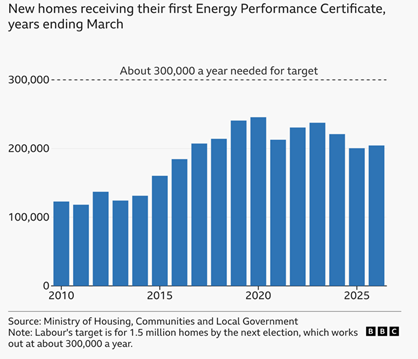
Because, as Ange excitedly announced her increase in housing starts, she was emptying her starting pistol into the building industry’s foot.
The reality is that most of the “headwinds” preventing the Government from reaching its housing target are blowing straight from Whitehall.
Here’s a selection of them:
- Gateway 2 delays – An under-resourced Building Control Authority means the regulator is taking months to approve high-rise schemes that are meant to be decided within 12 weeks.
- The Building Safety Levy – squeezing £3.4 billion out of the builders you’re relying on to build new residential development.
- Regulation Buckaroo – each department adds its own requirements without anyone calculating whether it will be the straw that breaks the Developers’ backs – altogether making houses unviable to build.
- A one-size-fits-all approach to regulatory cost – An extra £10,000 may be a small slice of a London flat’s value, but on a home in the Midlands or North, it can swallow a large chunk of the developer’s profit and make the project unviable.
- Biodiversity Net Gain – requiring developers to “prove”, following an insanely nebulous formula, that nature will be precisely 10% better off after they have built the homes – and maintain the resulting habitat for 30 years.
- Future Homes Standard – The Government wants 1.5 million new homes, but keeps adding to the cost of building each one with compulsory heat pumps, solar panels and ever tougher rules. This has added a cumulative £30,000 in additional taxes, levies and regulatory costs for every home built since 2020.
- “Affordable Housing” and Section 106 obligations – making marginal schemes unviable when piled on top of every other cost.
- Lack of effective first-time-buyer support following the end of Help to Buy – the Government says it will now address this. Fingers crossed.
- Regulatory Catch 22 – Government holding builders responsible for compliance while actively denying them clear or consistent guidance.
And many of the new regulations border on – sorry, gallop headlong into – the farcical: such as councils demanding £1,200 fake chimneys be sited on top of homes which are banned by those same councils from having fireplaces.
But let’s not forget the most destructive Labour housing policy of all…
The Government expects the developer to personally guarantee the safety of the completed building – before a brick has been laid – while banning them from asking the Regulator to explain the rules.
In effect, they must stake their legal and financial reputation on guessing whether the finished building – notwithstanding what happens on the building site, in the Government (or indeed the world) over the entire construction period – will be passed by the Building Safety Regulator, who is not allowed to tell them how to ensure it is compliant.
And then, on that shaky foundation, they must find someone willing to fund it.
But of course, thousands of homes are built in taller blocks, too. For those schemes, Gateway 2 isn’t a headwind. It’s a tornado: picking up viable developments and smashing them into the ground before work even starts.
Meet one builder being hit by this tornado
Garry Hall is a director of DBG, a regional developer building around 300 to 400 homes a year. His company bought a building for redevelopment before the new BSR regime came into force – but by the time he’d secured the funding and materials to build, the new regulations had sucked him into its vortex.
DBG diligently hired expert advisers and submitted the detailed designs and calculations required. Its first Gateway 2 application was rejected after the assessor dismissed the experts’ structural engineering opinion.
So DBG brought in someone Hall describes as ‘one of the most qualified building-control specialists in the country’. The team went through all the hoops again. That application failed too.
Meanwhile, the development finance had already been drawn down.
“I would say in interest alone it’s cost us circa £1 million,” Hall told CapitalStackers. “And we’re not a massive developer.”
A million pounds in interest. Not one home started.
That money did not buy another home, improve the design or make the building safer. It paid for time spent waiting. The meter kept running while the project sat on the kerb.
Eventually, DBG found a smart way round the impasse. The Sheffield site is on a steep slope. Measured from the lowest corner to the top, the building crossed the 18m height threshold that brought it within the regulator’s scope.
So Hall’s team split it physically in two. They ran a dividing wall through the structure and separated the services, creating two buildings which, measured individually, fell below the threshold. “Otherwise, we’d still be banging our heads against a wall now,” Hall said.
Thanks be to Starmer. In addition to flushing away a million pounds of a hardworking little company’s money, Government regulations forced skilled people to spend ever more time and money redesigning the scheme to get around an approval process that built no more homes and improved nothing.
Hall’s verdict was characteristically direct: “I just don’t think they know what they’re doing. I think the regulation was brought in, it was ill thought out and it was overkill.”
And we at CapitalStackers know what this means for our members putting up the money. Every month of regulatory delay adds interest to the builder’s bill and pushes repayment further away.
So has the Regulator improved at all?
To be fair, yes. The BSR’s latest published figures show approvals rose from 39% in the 12 weeks to August 2025 to 92% in the 12 weeks to August 2026 for new high-rise buildings and major conversions.
Which is a positive improvement – albeit from terrible to just bloody awful. Just to be clear:
- The median time to approval was still nearly twice the 12 week target.
- The 92% figure represents the Regulator getting its finger out and making just 50 decisions.
- And crucially, it excludes applications withdrawn (possibly people going bust or simply losing the will) or those ruled invalid – it is not 92% of everything submitted.
And, of course, none of this gets Garry’s million pounds back. Which could have been used to build more houses.
And now add the costs no one is adding up
The Home Builders Federation estimates that building a standard new home costs a developer £76,000 more than it did in 2020. Of that figure:
- £37,000 reflects higher material and labour costs.
- More than £23,000 is attributed to regulatory costs,
- Over £7,000 is taxes and levies,
- £7,000 can be sucked away by potential site-specific requirements.
So that’s £76K more that must be paid by either the developer or the homebuyer before the new building can become a home.
Which means the developer needs to either pay less for the land, or charge more for the houses.
The first option is fine – if the owner agrees to sell it for less. But if the builder already owns the site, it’s too late.
They can’t sell the houses for more if buyers can’t afford it.
And no sensible funder will lend against a projected loss.
So in the end, there’s nowhere left to push the cost – and the scheme is delayed, reduced or dropped.
This lands especially hard outside the most expensive markets. That £76,000 hump is a much bigger proportion of the price of a home in Lancashire or South Yorkshire than that of a London flat. Pile national costs onto lower-value homes and don’t be surprised when it’s the cheaper homes in the Midlands and North that don’t get built.
Nor can ministers rely on councils or housing associations to replace everything the private sector can’t afford to build. Government figures estimate that 71% of new-build completions in 2024–25 were for private-sector use.
Planning permission never laid a single brick
As for the number of permissions granted – this is where the headwinds become hot air. Releasing land and speeding up planning does help, to a degree. But a planning permission is only permission to try to build. It’s not a mortgage for the buyer, a loan for the builder or a guarantee that the completed homes will sell for more than they cost.
No matter how many ministers take photo-ops wearing hard hats, it puts a roof over nobody’s head.
In 2024–25, England gained 208,600 homes, of which 190,600 were new builds. The rest came chiefly from changes of use and conversions, after allowing for demolitions. Even the broader figure was down 6% on the previous year. That’s the gap between ministerial bluster and bricks and mortar.
Young buyers face their own brutal headwinds
In 2025 the median home in England cost 7.6 times median full-time annual earnings. Among those who managed to become first-time buyers in 2024–25, the median deposit was £36,500 – just shy of a whole year’s earnings for the average homebuyer.
So builders are buffeted on both sides: rising costs to produce homes and limits on what customers can pay for them.
Politicians wailing for “better” or “more affordable” homes is just noise.
This is what we mean by Regulation Buckaroo.
- The biodiversity team puts down its target.
- The building safety team sets its process.
- The energy team dictates its standard.
- The Treasury imposes its levy.
Each can defend its own decision.
But when the developer kicks off and the scheme falls over, who gets the blame?
If ministers are serious about 1.5 million homes, they should see the problems they’re creating in the round: Take actual schemes – including modest family homes in the Midlands and North – and put every tax, levy, design requirement, planning delay and financing cost on one sheet. Then compare them with the likely selling price and the buyer’s mortgage.
So set whatever target you like, Angela.
You can huff and you can puff but if the figures don’t add up, your homes target falls down.
You’re costing Britain’s builders millions. They can’t lay bricks in your hurricane headwinds. For pity’s sake, please switch off the fan.
Don’t invest unless you’re prepared to lose all your money. This is a high risk investment. You may not be able to access your money easily and are unlikely to be protected if something goes wrong. Take 2 minutes to learn more.